A phone call is rarely just a phone call. It’s how a medical appointment gets booked, how a parent learns their child is safe, how help gets summoned. Most people make calls like this without a second thought. Deaf and hard of hearing people often can’t.
A telephone carries sound. A service that only answers in speech can’t be used independently by someone who signs, or who can’t follow speech reliably down a phone line. A relay service removes that barrier: it connects two people who communicate differently, in real time, so the call becomes possible.
European law already says people with disabilities must be able to use electronic communications on the same terms as everyone else. In 2026, EUD and EFHOH set out to find out how true that is in practice.
What we did
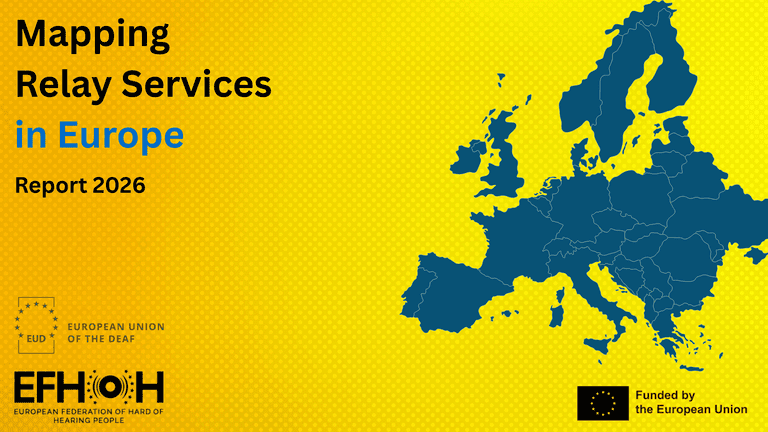
Between 8 April and 22 May 2026, EUD and EFHOH ran a joint survey of Video, Text and Speech-to-Speech Relay Services across Europe. We received 51 responses covering 30 countries, from organisations of deaf and hard of hearing people, relay service providers and national telecom regulators. Each response was validated and consolidated at country level before being included in the findings below.
Coverage remains uneven
Video Relay Services were identified in 25 of the 30 countries mapped, though some are limited to particular sectors. Only 12 countries have a confirmed, operating Text Relay Service. Finland’s national TRS ended in 2024. Just one dedicated national Speech-to-Speech Relay Service could be confirmed: Sweden’s Teletal.
24/7 access is still the exception
Only 8 of the 25 countries with a VRS offer continuous access, and only 7 of the 12 confirmed TRS. Where a service only runs during set hours, users simply cannot make a call once it closes.
Waiting times and call limits add extra barriers
Waiting queues are widespread for both VRS and TRS, with big differences between countries. Some services also cap the length or number of calls a user can make, even though a relayed conversation often takes longer than the same call made directly.
Emergency access is inconsistent
Some countries route emergency calls through the everyday relay service. Others use a dedicated emergency relay line. Either can work, but the outcome should be the same everywhere: a relay user should reach emergency services as fast as a hearing caller, with no extra steps.
Most services are free, but not without limits
Most relay services don’t charge users directly. Some apply relay specific charges, time allowances or usage limits that a voice caller would never face.
Cross-border access is one of the weakest points
Being able to reach your home country’s relay service from abroad doesn’t mean it works properly there, and a host country’s service may not support your language at all. That matters most exactly when it’s most urgent: travelling, or needing to reach emergency services abroad.
Quality is hard to measure
A few countries set measurable requirements for response time and quality. Most don’t publish data on waiting times, abandoned calls, accuracy or outages, so it’s often impossible to tell whether a relay service is actually delivering equivalent access.
What needs to change
The report closes with recommendations for the EU, Member States, telecom operators and relay service providers. The core ask is the same across all four: make relay services enforceable, not aspirational. Continuous 24 hour availability. Free and unlimited use. Fast, prioritised emergency access. Services that keep working across borders. Quality requirements that regulators actually check.
The Digital Networks Act, now before the European Parliament, is the chance to write those requirements into law. EUD and EFHOH will be pushing for that through the negotiations ahead.
The bottom line
Deaf and hard of hearing people should be able to make and receive a phone call with the same freedom, reliability and independence as anyone else. Relay services are the infrastructure that makes that possible. Their availability shouldn’t depend on the country, the time of day, or how someone communicates.
Read the full report: