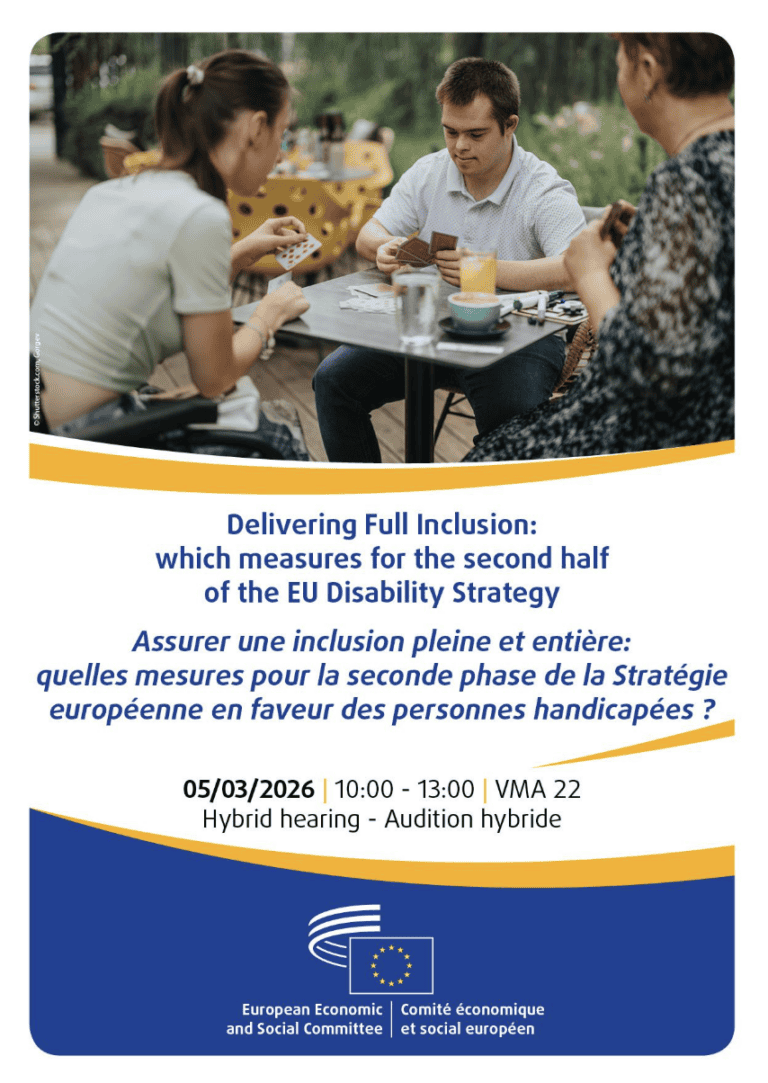
On 5 March, EUD Policy Manager Alexandre Bloxs attended the hybrid public hearing titled “Delivering Full Inclusion: which measures for the second half of the EU Disability Strategy?” organised by the European Economic and Social Committee (EESC) Permanent Group on Disability Rights in Brussels.
The event marked the midpoint of the EU Disability Strategy 2021–2030 and brought together representatives from EU institutions, Member State presidencies and disability organisations to reflect on progress so far and identify priorities for the second half of the Strategy.
During the first panel, which focused on EU leadership for disability rights, Alexandre addressed questions to representatives of the Cyprus and Ireland Presidencies of the Council of the EU. His intervention centred on the extent to which national organisations of persons with disabilities were involved in the preparation of each Presidency’s programme on disability rights. He emphasised the importance of meaningful consultation with disability organisations to ensure that policy priorities reflect the lived experiences of persons with disabilities.
In the second panel, which examined civil society perspectives on the future of the Strategy, Alexandre highlighted several key priorities from the perspective of the deaf community. He stressed the need for a legislative framework ensuring the accessibility of all EU institutions for persons with disabilities, including full accessibility in sign languages and the systematic provision of easy-to-read formats.
He also raised concerns about the ongoing barriers affecting the freedom of movement of deaf people within the European Union. While freedom of movement is a fundamental right, it remains particularly important for deaf people, as opportunities for quality and inclusive education and employment in sign language are often limited at the national level. As a result, many deaf people seek opportunities in other Member States. However, this mobility is significantly hindered by the difficulties in transferring or accessing essential social support services across borders, particularly sign language interpretation funded through national social-security systems.
EUD is closely monitoring developments related to the forthcoming action plan for the second phase of the EU Disability Strategy and will continue advocating for stronger guarantees for accessibility, mobility and linguistic rights for deaf people across the European Union.