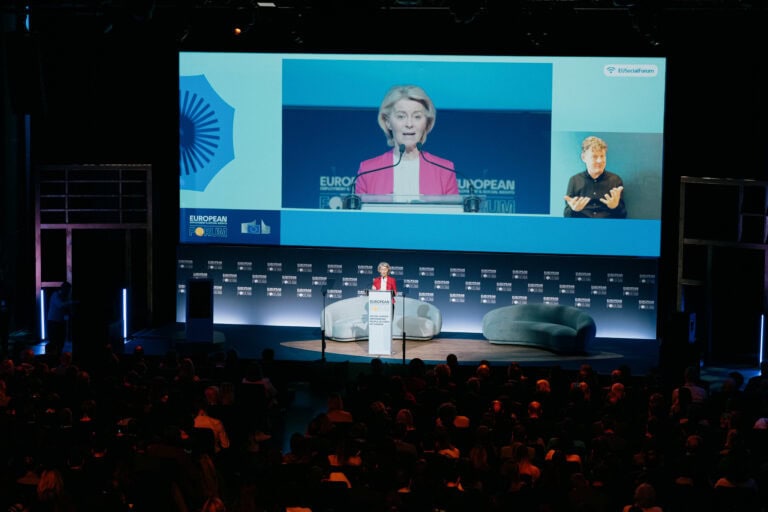
On 3–4 March 2025, Alexandre Bloxs, EUD Policy Manager, and Delphine le Maire, EUD Policy Officer attended the fourth European Employment and Social Rights Forum in Brussels. The event, organised by the European Commission, brought together policymakers, researchers, civil society organisations, and social partners to discuss the future of employment and social policies in Europe.
During the forum, European Commission President Ursula von der Leyen presented several key initiatives that will shape EU employment and social policies in the coming years. These include the upcoming Fair Labour Mobility Package, expected in autumn 2026, the Quality Jobs Act planned for December 2026, and the recently launched European Affordable Housing Plan. In addition, the European Commission is preparing an EU Anti-Poverty Strategy expected in the second quarter of 2026.
These initiatives form part of a broader vision for a stronger and more competitive Europe that also protects and supports its people. The European Commission emphasised the importance of strengthening the Single Market by reducing administrative barriers between Member States and enabling European companies to scale up more easily across the EU. At the same time, the EU aims to reinforce its strategic autonomy in key sectors such as energy and digital technologies.
The forum provided space to reflect on what a strong “social Europe” should look like in times of economic, technological, and environmental transformation. Discussions focused on reducing poverty, strengthening skills development, managing the green energy transition, addressing the impact of digitalisation and artificial intelligence, improving job quality, and removing barriers to labour mobility across the EU. Speakers presented statistics, research findings, and policy recommendations aimed at preparing both workers and companies for these ongoing changes.
One major theme was the skills gap across the European labour market. The European Commission’s Union of Skills initiative, launched in 2025, aims to address this challenge. Discussions highlighted the need for stronger public and private investment in human capital, starting from early childhood education and continuing through adult learning. Participants emphasised the importance of upskilling and reskilling workers throughout their careers, particularly through workplace training, to ensure that workers’ skills remain aligned with the evolving needs of employers and the wider economy.
Another key topic was the quality of employment in Europe. Eurofound presented its framework measuring seven dimensions of job quality: safety at work; income and employment-related benefits; work-life balance; employment security and social protection; social dialogue; opportunities for skills development and training; and workplace relationships and motivation. Evidence presented by Eurofound, the OECD, IndustriAll Europe, and SMEunited highlighted that higher-quality jobs contribute to increased productivity and economic resilience.
However, several speakers pointed out that job quality is under pressure in many Member States due to wage stagnation, rising living costs, and growing employment insecurity. Improving job quality requires recognising that workers have different priorities depending on their personal situations and life stages. For some workers, higher wages may be the most important factor, while for others flexibility, hybrid work arrangements, or a better work-life balance may be more significant.
Labour mobility across the EU was another central theme of the forum. While freedom of movement for workers is a fundamental principle of the European Union, regulatory differences between Member States continue to create obstacles for people seeking to work across borders. At the same time, discussions emphasised that mobility policies must also respect the right of workers to maintain their family and social ties if they choose to remain in their home country.
The European Union is also working to strengthen protections against labour exploitation, particularly for migrant workers. Initiatives such as the European Labour Authority aim to ensure that workers’ rights are better protected and that safe working conditions are guaranteed across the EU. In parallel, efforts are underway to simplify administrative procedures and facilitate cross-border mobility through digital solutions, including the development of the European Social Security Pass (ESSPASS).
During the discussions, EUD highlighted that labour mobility can present additional barriers for persons with disabilities, including deaf people. Through audience contributions, EUD raised the issue that deaf workers who move to another EU country may face significant difficulties accessing disability-related services and support systems, which remain organised primarily at national level.
The forum also addressed the importance of data and evaluation in shaping effective social policies. Research presented by the European Commission’s Joint Research Centre highlighted that certain groups, including persons with disabilities, are often underrepresented in data collection. As a result, they may be excluded from evidence-based policymaking processes and thereby preventing the achievement of the European Pillar of Social Rights objectives.
Participants discussed alternative and more inclusive evaluation methodologies that can better capture the experiences of underrepresented groups. Such evaluation activities are valuable not only for assessing the final outcomes of projects but also for improving project implementation, allowing organisations to adapt their actions and ensure that programmes remain aligned with the needs of the communities they serve.
EU funding instruments were also discussed, particularly the European Social Fund Plus (ESF+), which plays a central role in supporting employment, skills development, and social inclusion across the European Union. Beneficiaries of ESF+ funding have demonstrated through evaluations and practical results that the programme effectively contributes to these objectives. However, uncertainty surrounding the next EU Multiannual Financial Framework (MFF) raises concerns that this important funding instrument could be reduced or restructured, potentially affecting future support for disadvantaged groups, including deaf people and other persons with disabilities.
Thanks to the full accessibility provided by the European Commission, including on-site and online International Sign (IS) interpretation, the EUD policy team was able to actively participate in the presentations, panel discussions, and networking sessions.
Throughout the forum, EUD ensured that the perspectives of persons with disabilities, and especially deaf people, were included in the discussions. The event also provided valuable opportunities to engage with representatives from the European Commission, social partners, and organisations working on inclusive employment policies across Europe.
The discussions highlighted that building a competitive and socially inclusive Europe requires ensuring that everyone can participate fully in the labour market. For deaf people, this means ensuring access to quality jobs, opportunities for skills development, inclusive working environments, and effective implementation of disability-inclusive policies across the European Union.