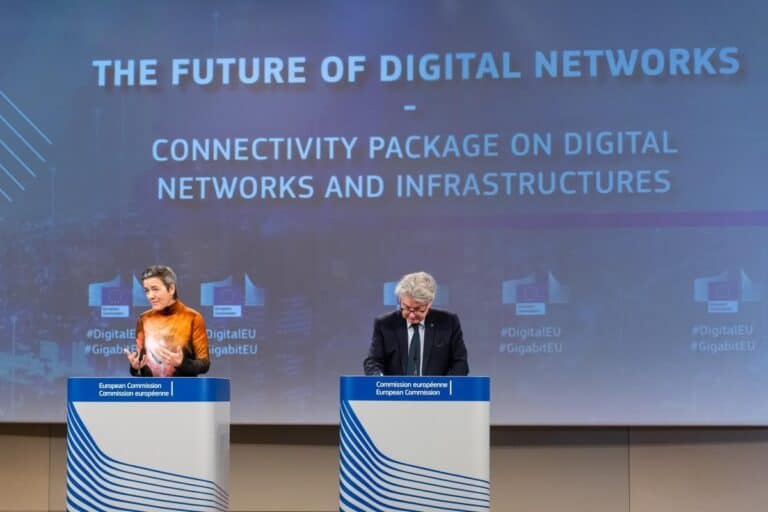
The European Union of the Deaf (EUD) has submitted proposed amendments to the Digital Networks Act (DNA), procedure 2026/0013(COD), the Regulation that is set to replace the European Electronic Communications Code (EECC) and to reshape the rules governing electronic communications across the Union. EUD transmitted its amendments to the rapporteur and the shadow rapporteur in the Committee on Industry, Research and Energy (ITRE), the committee responsible for the file, as well as to the rapporteurs for opinion in the Committee on the Internal Market and Consumer Protection (IMCO) and in the Committee on Civil Liberties, Justice and Home Affairs (LIBE).
Why EUD is engaging on this file
The DNA Proposal does not create new rights for end-users with disabilities compared with the EECC, and its provisions concerning persons with disabilities, including deaf people, remain excessively vague. They leave significant room for interpretation by Member States, which risks perpetuating rather than remedying the uneven implementation that characterised the EECC. EUD had already documented these shortcomings in its 2025 report on the implementation of the EECC and in its submissions to the Call for Evidence on the DNA, which were not adequately reflected in the Proposal.
EUD’s amendments are built around four priorities.
EUD’s amendments pursue four objectives. First, the Proposal refers to relay services without ever defining them hence the proposal from EUD therefore to provide clear definitions of relay services, including video relay services and text relay services. Second, the Proposal requires these services only “where necessary” which is why EUD calls for the removal of that caveat, for continuous availability, and for BEREC to establish quality requirements. Third, deaf end-users must be able to reach emergency services, including national emergency numbers and newer channels such as mobile applications, and to receive public warnings in national sign languages. Fourth, equivalent access should not be confined to a fixed location but should follow users wherever they are, including when they communicate through number-independent interpersonal communications services and when they travel in another Member State.
Presenting our recommendations in the European Parliament
On Monday 7 September 2026, EUD took part in a structured roundtable on the DNA hosted at the European Parliament by the ITRE rapporteur, MEP Kobosko, bringing together European organisations, civil society and the telecommunications industry. EUD used its intervention to set out its proposed amendments directly to the rapporteur, with a focus on definitions, the removal of conditional wording, 24/7 availability of relay services and accessible emergency communications. Sharing the same table as industry representatives made it possible to explain, in a forum where accessibility is too often treated as a secondary consideration, why equivalent access is a legal obligation under the CRPD and not an optional feature.
A joint letter on 24/7 relay services
In parallel, EUD joined forces with the European Disability Forum (EDF), the European Emergency Number Association (EENA) and the European Federation of Hard of Hearing People (EFHOH) to send a joint letter to the European Commission’s Executive Vice-President for Tech Sovereignty, Security and Democracy, Henna Virkkunen, and to the Presidency of the Council of the EU, the members of the ITRE Committee and the Secretariat of the Council.
The letter warns that Article 88(4) merely recommends that Member States make relay services available, repeating the flexible wording of the EECC that has produced very uneven levels of ambition. The 2026 research conducted by EUD and EFHOH shows that, of the 25 Member States analysed, only eight provide both text and video relay services, and only seven ensure video relay services on a 24/7 basis. The signatories of the letter ask that the DNA require all Member States to provide video and text relay services 24 hours a day and on any calendar day, including for reaching emergency services, subject to minimum quality requirements.
What comes next
Advocacy on this file is well under way. EUD will follow the work of the ITRE, IMCO and LIBE committees as amendments are tabled and the report is finalised over the coming months, and will continue to engage with the European Parliament in this sense. EUD will also extend its outreach to Member State representatives in the Council of the EU, which negotiates the file as co-legislator alongside the European Parliament.
This work will be supported by the joint EUD and EFHOH comparative research report on relay services in Europe, expected by the end of September 2026. Based on a mapping survey covering 30 countries, the report examines which types of relay services are available, when they can be used, how they can be reached in an emergency, and what quality and resources are attached to them, together with recommendations addressed to the EU institutions and to Member States.