


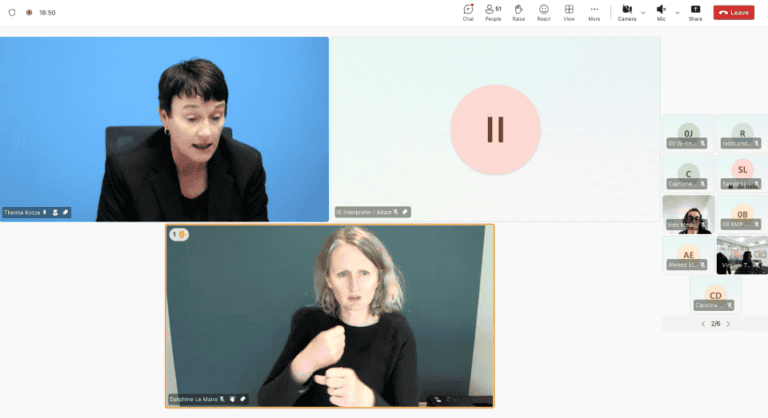
On 5 March 2026, the European Union of the Deaf (EUD) attended the European Commission’s online seminar titled Exchange of Views with Civil Society Organisations on Social and Employment Policies in the European Semester 2026. The event brought together EU-level and national civil society organisations, European Commission experts, and specialists working in the fields of human capital, social protection, and quality employment.
The seminar formed part of the consultation process within the European Semester, the EU’s annual cycle for coordinating economic, employment, and social policies among Member States. Each year, the cycle begins with the Autumn Package, in which the European Commission outlines the EU’s economic and social priorities and provides guidance to Member States. This is followed by the Spring Package, which includes Country Reports and Country-Specific Recommendations based on evidence and consultations with stakeholders, including civil society organisations.
During the seminar, representatives from the European Commission’s Directorate-General for Employment, Social Affairs and Inclusion (DG EMPL) presented the main social priorities for the 2026 European Semester. Particular attention was given to lifelong learning policies and the European Commission’s initiative on affordable and inclusive housing.
The seminar also provided civil society organisations with the opportunity to share their perspectives on key social aspects of the European Semester, including social protection and labour market inclusion. Participants were able to exchange directly with economic counsellors responsible for gathering country-specific data and evidence used in the preparation of the Country Reports and Country-Specific Recommendations that guide Member States’ economic and social policy reforms.
EUD actively contributed to the thematic discussion on social protection by highlighting the barriers faced by deaf people in accessing social services and employment-related support. In many countries, the insufficient provision of sign language interpreters and relay services prevents deaf people from accessing information about their rights, engaging with public administrations, and benefiting from employment and social protection systems. These barriers can result in the non-take-up of social rights, reduced participation in the labour market, increased risks of unemployment, and greater exposure to poverty and social exclusion.
To address this issue, EUD recommended the development of a dedicated sub-indicator within the European Semester monitoring framework to identify barriers to accessing social services and benefits. Such an indicator would help policymakers better understand the challenges faced by persons with disabilities, including deaf people, and support more inclusive policy responses across EU Member States.
The seminar also provided EUD with an important opportunity to strengthen its advocacy efforts by highlighting the importance of data and evidence in shaping inclusive social policies. In the future, EUD will investigate the opportunity to contribute to the European Semester process by sharing its research, data, and evidence-based reports with economic operators and the European Commission, helping ensure that the rights and needs of deaf people are better reflected in the development of future European Semester policy packages.


